Guide
Face, fingerprint or card: which time clock method?
Six ways to clock in, compared on what matters at a real entrance: queues, gloves and masks, credentials passed between colleagues, and what the law allows. From the team that installs LEM terminals across Cyprus.
- Card and NFC on every model
- Face on six models
- Fingerprint on three
Updated:
The short answer
For everyday attendance in Cyprus, use card, NFC, QR or PIN. They are quick, easy to replace and suitable for routine clock-in. Face recognition is the most convenient method and cannot be handed to a colleague, but the Cyprus Commissioner treats it, and fingerprint, as disproportionate for routine attendance. Keep biometrics for doors with a documented high-security need.
RFID card and NFC
A card or key fob is the default at most staff entrances. It reads with a tap, works with gloves, and a lost card is replaced with a new one. Every LEM model can be fitted with an RFID reader, an NFC reader or both, and the LEM 1009 also takes NFC clock-in from a phone.
The weakness is sharing: a colleague can tap someone else's card. The LEM Ai models and the Gate 8 take a photo at every clock-in and clock-out, so a manager can see who stood at the terminal.
QR code
The terminal's camera reads a code printed on a badge or shown on a phone. The LEM 1008 and 1009 use their camera only for QR, with no biometrics. For phone clock-in, the code shown at reception changes regularly (every minute by default), so a photograph of it cannot be reused later.
PIN
A PIN needs nothing to carry. It suits temporary staff and works as a fallback when a card stays at home. It is also the easiest to share, so use it as a backup rather than the only method.
Face recognition
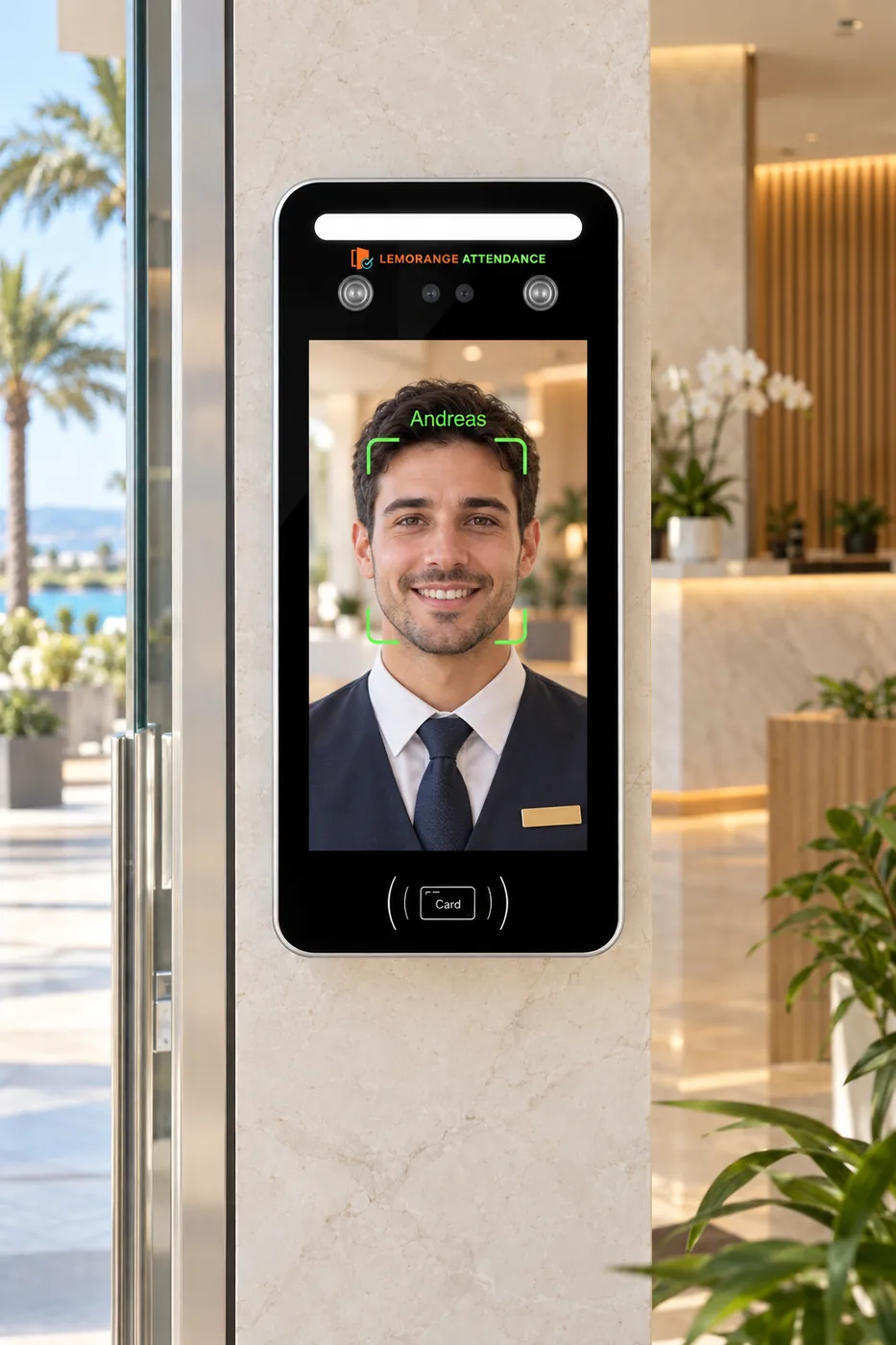
Contactless and quick. The LEM Ai8, Ai8 Pro, Ai10, Ai3 and Gate 8 recognise up to five people at once. The Ai8 Pro, Gate 8 and Ai3 recognise people wearing masks, and the Ai2's manufacturer lists masks among the appearance changes it handles. Every LEM face model has live detection that refuses photographs and video.
The law is the limit. In Cyprus, face recognition for routine attendance is treated as disproportionate. It fits a door with a documented high-security need, after a data protection impact assessment.
Fingerprint
A fingerprint cannot be passed to a colleague either, but it needs a clean, dry finger on the sensor. Gloves, dirt and wet hands cause failed reads, which slows a queue at shift change. The LEM Ai2, Ai8 Pro and Ai10 read fingerprints. The same legal limits apply as for face recognition.
Is a photo at clock-in biometric data?
Not by itself. Under the GDPR, a photograph counts as biometric data only when it is processed by specific technical means that identify or authenticate a person. A photo a manager looks at is still personal data, so it needs a lawful basis and a notice to staff. In Attendance, a terminal's clock-in photos are shown only to managers with access to that employee's records.
Sources: [3]
Combine methods per entrance
Set which methods count at each location, and whether one is enough or more than one is required. A common plan: card or NFC at every staff entrance, and face or fingerprint only at a server room or cash office where a documented assessment supports it, kept separate from the attendance record.
The six methods side by side
What each method means at the door, and where it stands for routine attendance in Cyprus.
| Method | At the door | Can a colleague use it? | Gloves or masks | Routine attendance in Cyprus | LEM models |
|---|---|---|---|---|---|
| RFID card | A tap | Yes, if the card is handed over | Works with gloves | Suitable | All eight, with an RFID reader fitted |
| NFC | A tap of a card or phone | Yes, if the card or phone is handed over | Works with gloves | Suitable | All eight, with an NFC reader fitted |
| QR code | A scan | Yes, if the code is shared | Works with gloves | Suitable | Ai10, Ai8 Pro, Ai8, Gate 8, Ai3, 1009, 1008 |
| PIN | A few key presses | Yes, if the PIN is told | Gloves slow typing | Suitable | All except the Gate 8 |
| Face | Walk up and look | No | Masks recognised on the Ai8 Pro, Gate 8 and Ai3 | Restricted to high-security access | Ai10, Ai8 Pro, Ai8, Gate 8, Ai3, Ai2 |
| Fingerprint | A touch | No | Gloves must come off | Restricted to high-security access | Ai10, Ai8 Pro, Ai2 |
Restricted follows the Cyprus Commissioner's Opinion 2/2018. General information, not legal advice.
Sources
- Cyprus Commissioner for Personal Data Protection, Opinion 2/2018 on CCTV and biometrics in the workplace (Greek; archived copy of 15 May 2025; the Commissioner no longer publishes it online)
- GDPR, Article 9: special categories of personal data
- GDPR, Recital 51: when a photograph is biometric data
- GDPR, Article 35: data protection impact assessment
General information, not legal advice. Your organisation remains responsible for its own legal assessment.
Questions about clock-in methods
Which clock-in method is best for routine attendance?
Card or NFC at the terminal, with PIN as a fallback. They are quick, work with gloves and are suitable for routine attendance in Cyprus.
Can employees clock in with their phone at the terminal?
Yes. The LEM 1009 takes NFC from a phone, and the models with a QR reader read a code shown on a phone.
Do face terminals work with masks?
The LEM Ai8 Pro, Gate 8 and Ai3 recognise people wearing masks. The Ai2's manufacturer also lists masks among the appearance changes it handles.
Can we use face recognition if every employee consents?
Not for routine attendance in Cyprus. The Commissioner's position is that consent in employment is not freely given, so it cannot make disproportionate biometric clock-in lawful.
Does a photo taken at clock-in count as biometric data?
Only when it is processed by technical means to identify or authenticate someone. A photo a manager looks at is still personal data and needs a lawful basis and a notice to staff.
Choose the method per entrance.
Tell us your entrances, the number of people and how they clock in today. We will suggest the method and the terminal for each door.